Exchange Tokens
Never Let Me GoExchange Tokens are the currency used at Hailsham’s seasonal student Exchanges: guardians assign tokens to submitted work, and students spend them on work made by others in their own year. More than a practical payment system, the tokens connect creativity to possessions, peer regard, and the disputed honor of having work selected by Madame. Their history shows how an apparently celebratory school custom also taught students to value, rank, and sometimes feel the loss of what they made.
Definition and operation
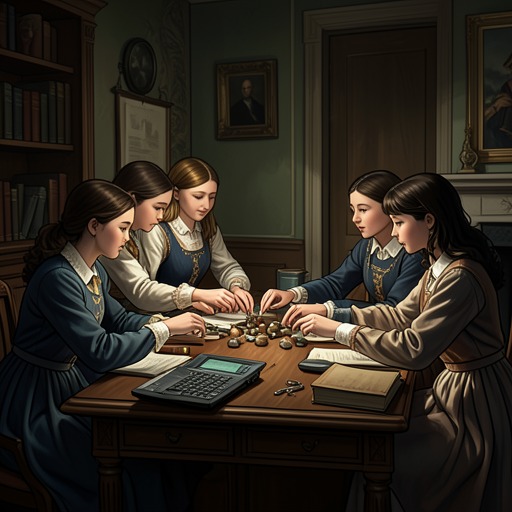
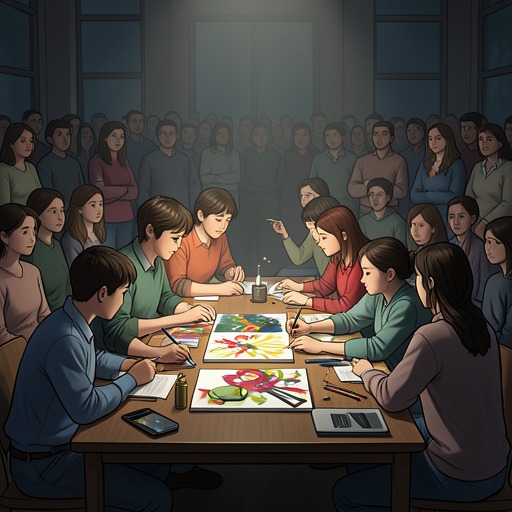
Four times a year, in spring, summer, autumn, and winter, students brought together the paintings, drawings, pottery, and improvised sculptures they had made since the previous Exchange. The guardians decided how many tokens each contribution merited. On the day of the Exchange, students used those tokens to buy work they liked, with one restriction: they could purchase only work made by students in their own year. The cycle thus joined individual production to a shared market in which students’ creations became other students’ possible possessions.
The Exchanges were one of the students’ few ways to build collections of personal belongings; the Sales offered another, separate means of acquiring things. Students could use their purchases to decorate the space around a bed, personalize a desk, or carry an object from room to room. Most kept these things in wooden chests marked with their names beneath their beds. They took care over what to display and what to put away, and, looking back, Kathy recalls former students becoming nostalgic about their collections. Tokens therefore had a life beyond the Exchange itself: they helped determine which objects students could make their own and preserve.
Creativity, value, and Hailsham status
The token system made students attentive to the assessed value of what they created. As they grew older, they became more interested in clothing, decorating their beds, personalizing desks, and building collections. Their work could be both an expression of making and a route to acquiring the possessions that gave their surroundings a personal character. Because students depended on one another to produce things they might want to own, the system also shaped their relationships. At Hailsham, how well a student was regarded—how much the student was liked and respected—was often bound up with skill at creating.
This everyday valuation sat alongside a different judgment: having work chosen by Madame was treated as a special distinction. At first, students saw work placed in the billiards room, or taken away by Madame, as a great triumph. By around the age of ten, however, the tokens they used to price and obtain things had made them more conscious of the marketable work they might be losing. The same object could consequently signify both recognition and an unrealized possession. The tension was not simply between art and money; it was between accepting selection as an honor and asking what students gave up when their most valued work left their hands.
The tokens controversy
That tension became a collective dispute known as the tokens controversy. It took place when the students were in Junior 4, although Kathy and Tommy later disagreed at first about its timing. Some students, mainly boys, argued that they should receive tokens as compensation when Madame took one of their works. Others were outraged by the proposal, and arguments continued among the students. The demand treated a selection not only as a distinction bestowed by Hailsham but also as the removal of something with an exchange value.
A student one year above Kathy’s group, who had already had several works taken by Madame, went to see Miss Emily, Hailsham’s head guardian, to press the case. Approaching her without being summoned was daunting, and the students expected a severe reprimand. Instead, Miss Emily did not give the anticipated telling-off. In the following days, reports circulated that guardians were discussing, and even arguing about, the question. The eventual decision was that students would receive tokens when Madame selected their work, but only a small number: the school presented the selection as a highly distinguished honor. The compromise pleased neither side, and the arguments continued.
The dispute also made explicit a boundary students had generally observed without discussing. During a library lesson, while the group was supposed to be reading a play, a joke about the controversy prompted Miss Lucy to invite them to spend the rest of the lesson discussing tokens. A student then asked why Madame took their things. The question shifted attention from the immediate argument over compensation to the purpose behind the practice of collecting student work. Kathy recalls feeling both angry at the breach of an unwritten rule and eager to hear the answer, a combination that captures how curiosity and discomfort surrounded the subject.
Objects, gifts, and the wider purpose of collecting
Much later, Miss Emily explained that the school’s collection of the students’ art had served a public argument about their humanity. Hailsham and other institutions in a small, vocal movement displayed selected works to influential visitors, seeking to demonstrate that students raised in humane, cultivated surroundings could be as sensitive and intelligent as ordinary human beings. In the late 1970s, when the movement was at the height of its influence, such events drew prominent attendees and support. Against that history, Madame’s selections carried a purpose larger than the students’ local dispute, even though the students experienced them through the immediate terms of honor, ownership, and tokens.
Kathy’s memories of objects received outside the Exchange system show why a possession’s value could exceed its usefulness or market price. After Kathy had lost her Judy Bridgewater cassette, Ruth gave her a tape called Twenty Classic Dance Tunes, found at the last Sale. It contained orchestral ballroom music and was nothing like the lost cassette. Kathy initially felt disappointed, then recognized that Ruth could not have known the difference and felt happiness at the kindness behind the gift. She kept the tape, rarely played it, and came to treasure it especially after Ruth was gone. The object’s importance rested not on its musical content but on the relationship and remembered gesture it carried.
Ruth’s later gift to Tommy offers another contrast with token exchange. During a trip with Kathy and Tommy, she handed Tommy a crumpled piece of paper bearing Madame’s address, so that he could keep it for when Kathy changed her mind and they could try to seek a deferral. The paper was not a purchase or a payment; its value came from Ruth’s intention to help them act on a possibility. Exchange Tokens made the value of student work explicit and countable. These personal objects and gestures show a different economy of attachment, in which an imperfect tape or a scrap of paper could matter because of who gave it and what the gift made possible.